
Georgia Northwestern Technical College’s (GNTC) Welding and Joining Technology program is one of its most in-demand programs because graduates feel a sense of satisfaction with their work, have high job placement rates and earn a high starting wage.
“If you like to build or create something with your hands that you can be proud of, Welding and Joining Technology is definitely the field for you,” said Billy Brown, Welding and Joining Technology instructor at GNTC. “We’ve had a lot of women in the program who were considering a different field but decided they wanted to build America’s and the world’s infrastructure.”
GNTC offers Welding courses at the Floyd County Campus in Rome, Polk County College and Career Academy in Cedartown, Walker County Campus in Rock Spring and Whitfield Murray Campus in Dalton.
GNTC’s Welding and Joining Technology diploma program, which takes approximately 18 to 24 months to complete, teaches Shielded Metal Arc (SMAW) Welding; Gas Metal Arc (GMAW) Welding, also called Metal Inert Gas (MIG) Welding; Flux Core Arc (FCAW) Welding; and Gas Tungsten Arc (GTAW) Welding, also known as Tungsten Inert Gas (TIG) Welding.
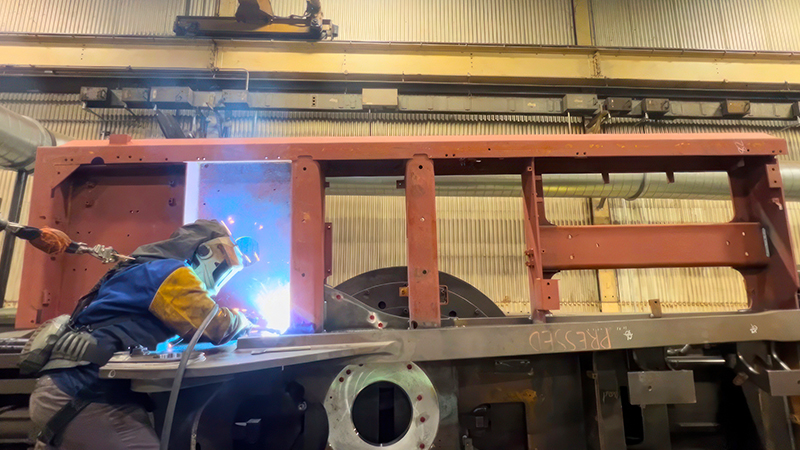
Instruction also covers equipment familiarity and safety, blueprint reading, fabrication, pipe Welding, structural plate Welding, joint techniques and an overview of other metals and alloys, such as aluminum and stainless steel, as well as Welding in the flat, horizontal, vertical and overhead positions.
Employees are currently needed in all specialties, said Shawn Daniel, instructor of Welding and Joining at GNTC.
Jeremiah Cooper, program director of Welding and Joining Technology at GNTC, said more than 300 of his students have been placed in the industry since 2015. He coordinated roughly half of those placements because employers reached out to him to ask if he had any graduates or students near completion of the program.
“We have an open line of communication with employers, whether it be owners, general managers, supervisors, shop foremen or just regular employees,” Cooper said. “Several alumni of the program have leadership roles with area companies, so that helps build the relationships.”
That open line of communication also allows GNTC instructors to share with students the skill sets employers are seeking for their companies, according to Cooper. Astec, Komatsu, Miller Industries, Scenic City Mechanical and Textron Inc. are among area manufacturers who have contacted GNTC to fill vacancies.
Welding is one of the programs included in the Technical College System of Georgia’s (TCSG) High Demand Career Initiative; TCSG identifies in-demand occupations that pay above-average entry-level wages and are deemed critical to the success of their industries and to Georgia’s economic vitality.
“High demand career fields represent the occupations in each of Georgia’s key industries that are in-demand, pay an above average entry-level wage and are considered strong options for pursuing a successful career in Georgia,” said Dr. Heidi Popham, GNTC president. “These occupations are critical to these industries’ success and Georgia’s economic health.”
“GNTC’s Welding and Joining Technology program can work magic in people’s lives,” Cooper said. “I’ve seen many people use the program as a springboard into a wonderful and successful career.”
Brown and Daniel said they have seen about 200 of their students hired in the last four years.
Brandon Johnson, GNTC’s most-recently-hired Welding instructor, said he estimates that 75 percent of his students have gone into Welding jobs in the last three years. He echoed the need for welders in industry.
Employers look for welders who are willing to learn, ask questions, practice good safety techniques, think on the fly and work well under intense stress, Daniel said.
“A lot of companies understand that they need to teach some students some things when they are hired,” Daniel said. “They learn to fabricate metal, drive forklifts and manlifts, and learn the Occupational Safety and Health Administration (OSHA) rules.
“I wasn’t familiar with Welding and just figured I would try it out,” said Cory Lewis, a welder and fabricator for Komatsu America Corp. in Chattanooga. “I enjoy how unique and creative it can be at times along with the difficult challenges.”
Lewis said he chose GNTC because his mother had received her Nursing degree from GNTC’s Walker County Campus, the campus’ proximity to his residence and his classes would be funded through financial aid and scholarships.
“The instructors are passionate about teaching, and they did a great job teaching me the fundamentals to prepare me for the workforce,” Lewis said.
Lewis appreciated the patience and support the instructors demonstrated, their candor when welds needed improvement and their willingness to put on a Welding hood and physically show him how to do a specific Welding technique.
Cooper told students that nearly everything around us is made with metal, including boats, bridges, buildings planes, trains and vehicles.
“Even a machine that makes shoes has parts on it that were welded,” Johnson said. “Welding is everywhere you look.”
Yosdel Castaneda received a diploma in Welding and Joining Technology from GNTC in 2024. She said her salary doubled when she left her part-time job and was hired for a full-time position at Astec Industries in Chattanooga, where she also received many new benefits, including health insurance and paid time off.
“I love that Welding is hands-on and challenging,” Castaneda said. “I’m always learning something new about how to weld certain metals and positions. No matter where the work is, I learn a whole new way to do the job. I learn from people with different experiences and gain more respect and understanding with each job.”
“GNTC prepared me for this career by teaching me the skills and helping me feel confident enough in my experience to pass the weld test,” Castaneda said. “I would’ve never been able to get a Welding job without my instructor’s encouragement.”
The Diesel Technology and Electrical Technology fields need employees who know how to weld, Brown said. While many students tend to specialize in one type of Welding, they need to know how to do them all.
While the majority of graduates go into Welding, others have gone into an array of professions, including positions as air conditioning technicians, artists, boiler makers, business owners, draftsmen, fabricators, iron workers, machinists, maintenance technicians, pipe fitters, plumbers, steam fitters, supervisors, welders, Welding instructors and Welding inspectors, Daniel said. Unions are also eager to hire welders.
Some welders have enlisted in the U.S. Army after graduating from GNTC, including one Dual Enrollment student, Brown said.
Most graduates last year earned a starting salary between $55,000 and $65,000, Cooper said.
Johnson said his graduates report starting out earning between $23-28 an hour; welders often work overtime, so their wages grow quickly.
Several companies who hire students while they are still attending GNTC work with the students’ schedules, and the college offers morning, afternoon and evening classes, Brown said. Morning classes start at 8 a.m., and evening classes end at 8 p.m.
“Today is the best time to get into Welding,” Cooper said. “Wages are higher than they have ever been, and there are more opportunities now than ever.” Georgia Northwestern Technical College delivers high-quality workforce education to the citizens of northwest Georgia. Students can pursue associate degrees, diplomas and certificates in a wide range of career pathways, including aviation, business, health, industrial and public service. Over the past year, 14,082 people benefited from GNTC’s credit and noncredit programs. The college has an annual credit enrollment of 9,342 students and achieved a 100 percent placement rate. An additional 4,740 individuals are served through adult education, continuing education, business and industry training and Georgia Quick Start® programs.